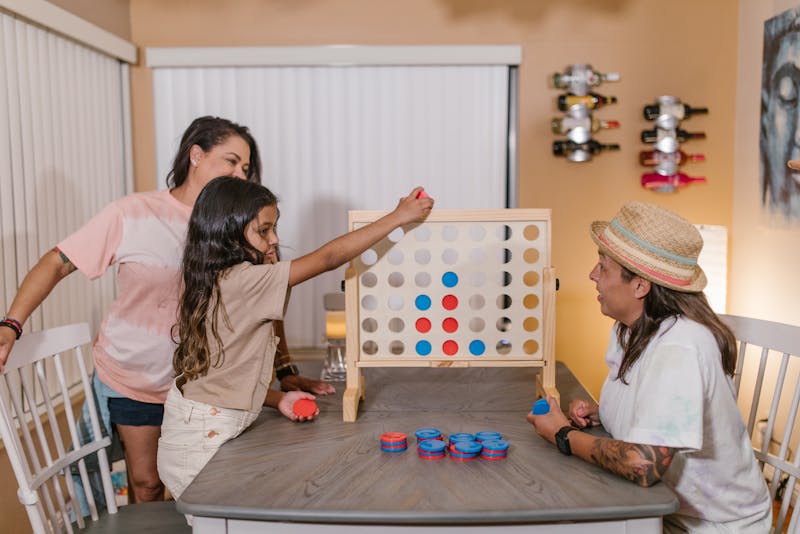
- Family card games are inclusive and versatile: They can be adapted for all ages, from young children to grandparents, making them ideal for mixed-age gatherings.
- Card games strengthen social bonds: Playing together encourages conversation, laughter, and friendly competition, helping families connect meaningfully.
- Games teach valuable skills: Many card games improve strategy, memory, math, patience, and social skills while keeping the experience fun.
- Choose games based on age, complexity, and player count: Simple games like Go Fish or Uno are great for younger children, while Rummy, Spades, and Hearts offer more strategy for older players.
- Fast-paced games keep everyone engaged: Games like Snap, War, and Crazy Eights are quick, interactive, and perfect for shorter attention spans.
- Game nights can be enhanced with simple tips: Dedicated spaces, snacks, rotating games, small prizes, and visible rules make family card nights more enjoyable.
- Card games are portable and flexible: A deck of cards can be taken anywhere, providing entertainment for vacations, road trips, holidays, or rainy afternoons.
Family time is precious, and finding activities that everyone can enjoy is often a challenge. One of the easiest and most engaging ways to connect with loved ones is through family card games. Whether your group includes young children, teenagers, or grandparents, card games provide endless opportunities for fun, laughter, and bonding. In this article, we’ll explore 10 family card games everyone can play, with tips, rules, and variations to keep the experience exciting for all ages.
Why Are Family Card Games So Popular?
Card games have been around for centuries, and their appeal hasn’t faded. Here’s why family card games continue to be a favorite:
- Accessibility: Most families already have a deck of cards at home.
- Flexibility: Card games can be adapted for different ages and skill levels.
- Portability: A deck of cards is easy to take on vacation, to the park, or even to grandma’s house.
- Social interaction: Card games encourage conversation, laughter, and friendly competition.
- Mental exercise: Many card games require strategy, memory, and critical thinking.
If you’ve been looking for ways to unplug from screens and bring your family together, card games are a simple and effective solution.
How Do You Choose the Right Family Card Game?

Not all card games are suitable for everyone. When choosing a game, consider the following:
- Age range: Can young children understand the rules, and are older players still challenged?
- Number of players: Make sure the game accommodates the size of your family.
- Game length: Some games take 10 minutes, while others can last hours. Pick one that fits your schedule.
- Complexity: Avoid overly complicated games for mixed-age groups.
- Interaction style: Decide if you want competitive games or cooperative ones.
Once you know what works best for your family, you can explore a variety of card games designed to keep everyone engaged.
1. Uno: A Classic for All Ages
Uno is a household favorite for families, and its simple rules make it easy for kids to learn while still providing excitement for adults.
How to Play:
- Each player starts with seven cards.
- Match cards by color or number.
- Special cards like Skip, Reverse, and Draw Two add twists to the game.
- The first player to play all their cards wins.
Why Families Love It:
- Fast-paced gameplay keeps everyone involved.
- Colorful cards are visually appealing for younger players.
- Easy to adapt rules for beginners.
Tips for Mixed-Age Play:
- Let younger children skip challenging cards.
- Use house rules to speed up longer games.
2. Go Fish: Perfect for Younger Children
Go Fish is a simple, fun, and educational card game that teaches memory, matching, and strategy.
How to Play:
- Each player gets five cards.
- Players ask others for specific cards to make pairs.
- If the requested card isn’t available, the player “goes fishing” from the deck.
- The player with the most pairs at the end wins.
Why Families Love It:
- Quick rounds keep young children engaged.
- Encourages social interaction and communication.
- No complex strategy needed, making it beginner-friendly.
Variations for Older Players:
- Increase the hand size for a longer game.
- Introduce a point system for extra challenge.
3. Crazy Eights: Simple Yet Strategic
Crazy Eights is a flexible card game that works well for children, teens, and adults.
How to Play:
- Each player is dealt five cards (or seven for smaller groups).
- Match the top card in the discard pile by suit or number.
- Eights are wild and can be played at any time.
- The first player to empty their hand wins.
Why Families Love It:
- Quick setup and fast rounds.
- Encourages thinking ahead and planning moves.
- Eights add an element of surprise and excitement.
Tips:
- Modify rules to make it cooperative for younger children.
- Use multiple decks for large groups.
4. Old Maid: A Timeless Favorite
Old Maid is a classic game that has entertained generations with its simple mechanics and suspense.
How to Play:
- Remove one queen from a standard deck or use a special Old Maid card.
- Players make pairs from their hands and discard them.
- The goal is to avoid being left with the unmatchable card.
- The player holding the Old Maid at the end loses.
Why Families Love It:
- Easy for children to understand.
- Provides lighthearted suspense.
- Quick and engaging rounds.
Variations:
- Customize with themed decks, like animals or cartoon characters.
- Play multiple rounds and keep a scoreboard for added fun.
5. Snap: Fast Reactions and Laughter
Snap is a high-energy card game perfect for kids who enjoy quick reflexes and excitement.
How to Play:
- Deal all cards equally among players.
- Players take turns flipping cards onto a central pile.
- When two consecutive cards match, players race to shout “Snap” and claim the pile.
- The player with the most cards at the end wins.
Why Families Love It:
- Encourages quick thinking and observation.
- Fun and chaotic, creating lots of laughs.
- Short rounds make it ideal for restless kids.
Tips:
- Play in teams for larger families.
- Use themed cards for variety.
6. Rummy: Strategy for the Whole Family
Rummy is a classic game that involves matching sets and sequences, offering more strategy for older children and adults.
How to Play:
- Each player is dealt a set number of cards.
- Players take turns drawing and discarding to form sets (three or four of a kind) or runs (consecutive cards of the same suit).
- The first player to arrange all their cards into valid sets and runs wins.
Why Families Love It:
- Combines luck and strategy.
- Can be adapted for longer or shorter sessions.
- Appeals to both children learning numbers and adults enjoying competition.
Tips:
- Simplify rules for younger players.
- Introduce Jokers as wild cards to add excitement.
7. War: Simple and Fast-Paced
War is a game of chance that is perfect for younger players and quick matches.
How to Play:
- Split the deck evenly among players.
- Each player flips the top card of their deck.
- The highest card wins the round and takes the cards.
- In the event of a tie, “war” is declared, and additional cards are flipped.
- The player with all the cards at the end wins.
Why Families Love It:
- Requires no strategy, making it ideal for children.
- Fast rounds keep everyone engaged.
- Easy to teach and quick to play.
Variations:
- Speed up the game by setting a time limit.
- Play in teams for larger groups.
8. Spades: Team Play and Strategy
Spades is a trick-taking card game that encourages teamwork and strategic thinking.
How to Play:
- Players form two teams.
- Players bid the number of tricks they think they can win.
- Spades are always the trump suit.
- Score points for meeting bids, and avoid penalties for failing.
Why Families Love It:
- Encourages collaboration and planning.
- Offers a deeper level of strategy for older players.
- Can be played casually or competitively.
Tips for Families:
- Pair adults with children for guidance.
- Use simplified scoring for younger players.
9. Slapjack: Fun for Quick Reflexes
Slapjack is a fast and interactive game suitable for energetic families.
How to Play:
- Deal all cards evenly among players.
- Players take turns flipping cards into a central pile.
- When a jack appears, players race to slap it first.
- The player who slaps the jack takes the pile.
- The player with all the cards at the end wins.
Why Families Love It:
- Promotes quick thinking and attention.
- Great for kids who enjoy movement and excitement.
- Easy to understand and play in short bursts.
Tips:
- Play on a soft surface to prevent damage or injury.
- Rotate the dealer each round for fairness.
10. Hearts: Classic Trick-Taking Fun

Hearts is a traditional card game that’s perfect for families who enjoy strategy and careful planning.
How to Play:
- Each player is dealt 13 cards.
- Players aim to avoid winning tricks that contain hearts or the Queen of Spades.
- Points are scored for each heart or the Queen of Spades.
- The player with the lowest score at the end of the game wins.
Why Families Love It:
- Combines strategy with friendly competition.
- Offers a slightly more advanced challenge for older children and adults.
- Flexible for two to six players, making it ideal for family gatherings.
Tips for Families:
- Teach younger children the concept of avoiding certain cards before full games.
- Play shorter rounds to maintain interest.
How Can You Make Card Game Nights More Fun?
Card games are great on their own, but you can make family game nights even more enjoyable with a few simple tips:
- Create a dedicated game space: Set up a table with good lighting and comfortable seating.
- Include snacks and drinks: Keep the energy up with finger foods or themed treats.
- Rotate games: Avoid repetition by mixing classic and modern card games.
- Add small prizes: Encourage friendly competition with fun rewards.
- Keep rules visible: Print out simplified rules for younger players.
Can Card Games Teach Important Skills?
Yes. Beyond fun, family card games can teach valuable life skills:
- Patience: Waiting for your turn develops patience and self-control.
- Strategy and planning: Many games encourage thinking ahead and adapting tactics.
- Social skills: Games promote communication, negotiation, and cooperation.
- Math and memory: Counting, matching, and remembering cards strengthen cognitive skills.
Tips for Introducing Card Games to Mixed-Age Families
Introducing card games to a family with mixed ages can be challenging. Consider these strategies:
- Start with simple games like Go Fish or Uno for younger children.
- Pair children with adults for guidance in more complex games.
- Encourage house rules that level the playing field.
- Use cooperative games to reduce frustration in competitive games.
- Gradually introduce more strategic games as children grow.
Wrapping It Up
Family card games are more than just entertainment—they’re a way to connect, bond, and create lasting memories across generations. From fast-paced games like Snap to strategy-heavy games like Hearts, there’s a card game for every age and interest. By keeping the games engaging, inclusive, and fun, families can enjoy countless hours of screen-free entertainment.
Whether you’re playing on a rainy afternoon, at a holiday gathering, or during a vacation, family card games provide a timeless way to laugh, learn, and grow together. So grab a deck of cards, gather your loved ones, and let the games begin.